Stars, planets, moons, black holes and rockets: 35 cards, five stats, from a 685 kg space probe to a black hole as heavy as six and a half billion Suns. Pick the cards you want, how the numbers read, and print them with their backs and a rules card.
Real numbers, one rule each. Every stat is measured the same way on every card: speed is always compared with the Sun, distance is always the farthest it gets from Earth. Some numbers are measured, some calculated, a few only estimated; the fact-check ledger says which, card by card. Habitability is a designed game rating: how long a person could stay alive there, and how much gear it would take. No galaxies: the Milky Way would win every round. See the definitions ↓
Explore the pack
The space line-up
Bigger number wins. Drag a title to move it; double-tap to put it back.
Choose your cards · 35 of 35 in your deck
Untick a card to leave it out of the line-up, the matches and the printout.
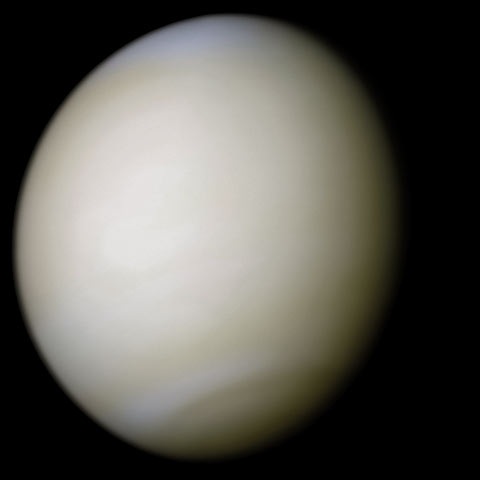
Venus is the hottest planet, even hotter than Mercury, because its thick clouds trap heat like a blanket. It spins backwards, so there the Sun rises in the west.
Twelve astronauts walked on the Moon between 1969 and 1972. With no wind or rain, their footprints are probably still there. It always shows Earth the same face.
Mars is red because its dust is rusty. It has the tallest volcano in the solar system, Olympus Mons, about two and a half times as tall as Mount Everest.
Millions of rocky lumps circle the Sun between Mars and Jupiter. Space is so empty there that spacecraft fly straight through. Squashed together, they would make less than a twentieth of our Moon.
Jupiter is the biggest planet: more than 1,300 Earths could fit inside. Its Great Red Spot is a storm wider than Earth that has raged for well over a century.
Io has more active volcanoes than anywhere else in the solar system. Jupiter’s pull squeezes it like a stress ball, heating its insides, and some eruptions throw plumes 400 km up.
Under Europa’s icy shell is probably a salty ocean with about twice as much water as all of Earth’s oceans. Scientists think it is one of the best places to look for life.
Ganymede is the biggest moon in the solar system, bigger than the planet Mercury. It is the only moon with its own magnetic field, and has a salty ocean hidden deep below.
Saturn’s rings are billions of chunks of ice, some as small as sand and some as big as houses. Saturn is so light for its size that it would float in a giant bath.
Titan is the only moon with thick air, and the only place besides Earth with lakes on its surface. They are filled with liquid methane, not water, and it even rains methane.
Enceladus is tiny, but it shoots giant jets of water from cracks near its south pole. They come from an ocean under the ice, and the spray makes one of Saturn’s rings.
Uranus rolls round the Sun on its side, probably knocked over by a giant crash long ago. So each pole gets about 42 years of sunshine, then 42 years of darkness.
Triton goes round Neptune backwards, the only big moon that does, so it was probably captured from farther out. Voyager 2 saw geysers on it shooting dark plumes 8 km high.
Pluto is a dwarf planet, smaller than our Moon. It has a giant heart-shaped plain of nitrogen ice, which the New Horizons spacecraft photographed when it flew past in 2015.
Halley’s Comet is a dirty snowball that swings past the Sun every 75 or 76 years, growing a glowing tail. It last came in 1986 and will be back in 2061.
Proxima Centauri is the nearest star to the Sun, but its light still takes over four years to reach us. It is far too faint to see without a telescope, and has at least one planet.
TRAPPIST-1e is a rocky planet about the size of Earth, circling another star 40 light-years away. Its year lasts six days, and it might have seas. Nobody knows yet.
Betelgeuse is the red star at Orion’s shoulder. It is so big that, put where our Sun is, it would swallow Mercury, Venus, Earth and Mars. One day it will explode.
Stephenson 2-18 is one of the biggest stars known. Put where our Sun is, it would reach almost to Saturn. The light we see left it before the first farms on Earth.
The Crab Pulsar is a dead star only 20 km wide, yet heavier than the Sun. It spins 30 times a second, sweeping beams of light across space like a lighthouse.
A giant black hole sits at the centre of our galaxy, four million times heavier than the Sun. Not even light can escape its pull. We first saw its shadow in 2022.
26 · Black hole · tap the picture or fact for anotherPhoto & sources ↗
This black hole in another galaxy was the first ever photographed, in 2019. It is as heavy as six and a half billion Suns, and wider than the orbits of all our planets.
27 · Black hole · tap the picture or fact for anotherPhoto & sources ↗
One of the biggest black holes ever found: about 40 billion times as heavy as the Sun. The light we see from the blazing gas around it set off 10.8 billion years ago, before Earth existed.
28 · Black hole · tap the picture or fact for anotherPhoto & sources ↗
Saturn V took astronauts to the Moon. It is still one of the most powerful rockets ever flown, and as tall as a 36-storey building. Only the little capsule on top came home.
29 · Spacecraft · tap the picture or fact for anotherPhoto & sources ↗
Falcon 9’s first stage flies back and lands upright on a ship or a landing pad, so it can be used again. Some of its boosters have flown more than 25 times.
30 · Spacecraft · tap the picture or fact for anotherPhoto & sources ↗
Starship is the biggest, most powerful rocket ever flown. Its booster comes home and is caught out of the air by giant metal arms on the launch tower, nicknamed the chopsticks.
31 · Spacecraft · tap the picture or fact for anotherPhoto & sources ↗
People have lived on the International Space Station without a break since November 2000. It goes round Earth every 93 minutes, so its crew see 16 sunrises a day.
Voyager 1 left Earth in 1977 and is the farthest thing people have ever made. Its radio messages now take a whole day to reach us. It carries a golden record of Earth’s sounds.
Parker Solar Probe is the fastest thing people have ever built. Diving past the Sun at 430,000 mph, it could fly from London to New York in about 30 seconds.
34 · Spacecraft · tap the picture or fact for anotherPhoto & sources ↗
The Webb telescope is a time machine. It catches light that set off over 13 billion years ago, showing galaxies as they looked when the universe was brand new.
35 · Spacecraft · tap the picture or fact for anotherPhoto & sources ↗
Nothing found. Try another name or type, or tick more cards above.
Make it real
Print your deck
Four cards to an A4 sheet, at 90 × 128 mm. Only the cards ticked above print, showing the numbers as you chose them, followed by the rules and stats cards below, which explain only the options you picked. For double-sided printing choose Fronts and backs and, in the print dialog, flip on long edge: each sheet of backs follows its sheet of fronts, mirrored so every back lands behind its own card. Print at 100% (not “fit to page”).
SUPER STATS
SPACE
The back of every card. Change its words and font above.
How to play
Deal all the cards face down. Look only at your top card.
The youngest picks a stat and reads it out: “Speed, 66,700!”
Everyone reads that stat from their top card. Highest wins.
The winner takes the cards to the bottom of their pile and picks next.
A tie? Cards go in the middle; the next winner takes them too.
Out of cards, you’re out. Last player with cards wins.
Switcheroo: every third round, lowest wins.
The stats
Weight
Rockets full of fuel. log2 kg: how many times you double 1 kg to get there (Earth 82.3). +1 is ×2 as heavy.log2 g: how many times you double 1 g to get there (Earth 92.3). +1 is ×2 as heavy.log2 tonnes: how many times you double 1 tonne to get there (Earth 72.3). +1 is ×2 as heavy.kg. 6×1024 is 6 with 24 zeros. Bigger raised number wins; if equal, the bigger front number.kg, in words. Each word is 1,000 times the last: million, billion, trillion, quadrillion, quintillion, sextillion, septillion, octillion…g. 6×1024 is 6 with 24 zeros. Bigger raised number wins; if equal, the bigger front number.g, in words. Each word is 1,000 times the last: million, billion, trillion, quadrillion, quintillion, sextillion, septillion, octillion…tonnes. 6×1024 is 6 with 24 zeros. Bigger raised number wins; if equal, the bigger front number.
Speed
Compared with the Sun (the Sun is 0). Rockets: their own top speed. Rockets and moons ride with their planet. Rockets: Earth’s speed plus their own.log2 mph: how many times you double 1 mph to get there (Earth 16.0). +1 is ×2 as fast.log2 m/s: how many times you double 1 m/s to get there (Earth 14.9). +1 is ×2 as fast.log2 km/h: how many times you double 1 km/h to get there (Earth 16.7). +1 is ×2 as fast.log2 mm/s: how many times you double 1 mm/s to get there (Earth 24.8). +1 is ×2 as fast.mph: Earth 66,700.m/s: Earth 29,800.km/h: Earth 107,000.mm/s. 6×1024 is 6 with 24 zeros. Bigger raised number wins; if equal, the bigger front number.
Temperature
At the surface; black holes: the hole itself; rockets: the flame. Kelvin starts at the coldest anything can be, so no minus numbers. Earth is 288 K.°C: water freezes at 0. Below that is minus: −20 beats −200.°F: water freezes at 32. Below 0 is minus: −20 beats −200.log2 K: how many times you double 1 K to get there (Earth 8.2). +1 is ×2 as hot.
Distance
The farthest it gets from Earth. log2 km: how many times you double 1 km to get there (Mars 28.6). +1 is ×2 as far.log2 m: how many times you double 1 m to get there (Mars 38.5). +1 is ×2 as far.log2 miles: how many times you double 1 mile to get there (Mars 27.9). +1 is ×2 as far.log2 AU: how many times you double 1 AU to get there (Mars 1.4). +1 is ×2 as far. Below 1 it goes minus; Earth is −∞, the lowest.log2 ly: how many times you double 1 light-year to get there (Mars −14.5). +1 is ×2 as far. Below 1 it goes minus; Earth is −∞, the lowest.km. 6×1024 is 6 with 24 zeros. Bigger raised number wins; if equal, the bigger front number.km, in words. Each word is 1,000 times the last: million, billion, trillion, quadrillion, quintillion, sextillion, septillion, octillion…m. 6×1024 is 6 with 24 zeros. Bigger raised number wins; if equal, the bigger front number.m, in words. Each word is 1,000 times the last: million, billion, trillion, quadrillion, quintillion, sextillion, septillion, octillion…miles. 6×1024 is 6 with 24 zeros. Bigger raised number wins; if equal, the bigger front number.miles, in words. Each word is 1,000 times the last: million, billion, trillion, quadrillion, quintillion, sextillion, septillion, octillion…AU: Earth–Sun distances (150 million km). Mars 2.7. A minus raised number is a fraction: 10−3 is 0.001.Light-years: how far light goes in a year, 9.5 trillion km. Proxima 4.2. A minus raised number is a fraction: 10−3 is 0.001.
Habitability
How long could a person stay alive there, and with what gear? For a rocket: riding inside it.
10 A whole lifetime, no gear at all.
9 Months, living in a space station.
8 Months in a crew spaceship (built, not yet flown).
7 Days to weeks inside a spaceship.
6 Days in a spacesuit, sleeping in a lander.
5 Hours in a spacesuit; no one has been yet.
4 Hours in a spacesuit, till the air runs out.
3 Under a day, even in a spacesuit.
2 A few hours: radiation gets through the suit.
1 Minutes, whatever you wear: crushed and cooked.
0 Destroyed at once.
For the grown-ups
The fact-check ledger
Every number on every card, where it came from, and how good it is. NASA’s Planetary Fact Sheet is the baseline for the planets, the Moon and Pluto; papers (mostly as cited by Wikipedia) for the moons, stars and black holes. “Measured”, “calculated” and “estimate” mean what they say. Speeds over a million mph and distances are rounded to two significant figures on the cards, which hides small differences.
Definitions: what the five stats mean, in full
Weight (kg). Mass in kilograms, rounded to two significant figures. A rocket is weighed full of fuel, on the pad. Shown by default as a log, base 2 unless the page’s Log base option says otherwise: how many times you would double 1 kg to reach it (Earth, 6×10²⁴ kg, is 82.3). Page options show it as log grams or log tonnes (log₂ g is always 10.0 more than log₂ kg), or as kilograms, grams or tonnes in full.
Speed (mph). Speed compared with the Sun, in miles per hour: one frame for every card, so the Sun itself is 0. Anything circling the Sun gets its average speed round it, with one exception: Parker Solar Probe gets the fastest it has gone, since that record is what it is for (its average is about Mercury’s). A moon, or a rocket on Earth, travels round the Sun with its planet, so it gets the planet’s average; its own motion round the planet adds or takes away some at any moment, and the ledger gives it. Stars and black holes beyond the solar system get how fast they and the Sun are moving relative to each other now, and a planet of another star gets its star’s; where only the toward-or-away part, or only the part across the sky, has been measured, the card shows that part and the ledger says so. A vehicle that rides with Earth (the rockets and the space station) can instead show its own top speed relative to Earth, or that added to Earth’s (the Rocket speed option). Shown by default as log mph (base 2 unless changed); page options show log m/s, log km/h or log mm/s, or mph, m/s, km/h or mm/s in full (three figures).
Temperature. Kelvin, which starts at absolute zero (−273 °C), so there are no negative numbers; page options show °C, °F or log K instead (a black hole’s tiny temperature has a big negative log). Planets, moons and asteroids: average surface temperature (a planet of another star: what its star’s light alone would warm it to, calculated) (giant planets: at the cloud tops, where the air pressure is the same as at sea level on Earth). Stars: surface temperature. Black holes: the hole itself, as theory predicts (Hawking temperature), not the glowing gas around it. Spacecraft: the hottest working part (a rocket’s engine flame; Voyager’s nuclear battery), or for the space station the hottest its outside gets in sunlight; Parker’s heat shield and Webb’s sunshield, the hottest they are built to get.
Distance (km). The farthest it gets from Earth, in kilometres. Planets: the farthest their orbits allow (on the far side of the Sun), from NASA’s fact sheet. Moons: their planet’s. Stars and black holes: how far away they are. Spacecraft: the farthest they have carried people (Starship, with no one aboard yet, its highest test flight; the space station its height); a probe or telescope that carries no one, the farthest it gets (Voyager 1 where it is now, November 2026; Parker Solar Probe and the Webb telescope the farthest their orbits allow). Earth is 0, the lowest. Page options show it as log km (the default, base 2 unless changed), log metres, log miles, log AU or log light-years, or in full in km, metres, miles, AU or light-years. In log AU and log light-years, everything nearer than one is a minus number, and Earth’s 0 is −∞, the lowest.
Habitability. How long a person could stay alive there with the best equipment people have (or, for Starship, have built for it), and how much equipment that takes: a designed 0–10 game rating, from facts. For a spacecraft, “there” is aboard it in space. Each card’s note says what is KNOWN (people have done it) and what is an estimate. See the bands. (Until 5 November it rated possible microbial life; Misha asked for survival.)
Habitability bands
10: A whole lifetime, with no equipment at all. Only Earth.
9: Months to a year, living aboard a space station; people do it all the time (the space station).
8: Months, inside a spaceship built to keep a crew alive; built, not yet done (Starship).
7: Days to weeks, inside a spaceship’s life support, in ordinary clothes; people have done it.
6: Days, in a spacesuit with a lander to sleep in; people have done it (the Moon).
5: Hours in a spacesuit (or, on Titan, warm clothes and an oxygen mask), perhaps years in a base; no one has been yet.
4: Hours in a spacesuit, until the oxygen runs out: no air and freezing, but no deadly radiation.
3: Less than a day even in a spacesuit: deadly radiation or scorching sunlight.
2: A few hours at most: radiation strong enough to kill through a spacesuit.
1: Minutes at most, whatever you wear: crushed and cooked.
0: Destroyed at once: a star, or a black hole.
Size? Each card’s object beside something familiar at one scale: planets and moons beside Earth (Earth beside the Moon), stars and Sagittarius A* beside the Sun, the biggest stars and M87* put where the Sun is inside a planet’s orbit, Halley beside Mount Everest, rockets beside Big Ben’s tower and Voyager beside a person. Not a game category.
Weight (kg): 2×10³⁰ (2 nonillion). NASA: 1.989×10³⁰ kg. Measured (from the planets’ orbits).
Speed (mph): 0 (0). Every speed in this pack is measured against the Sun, so the Sun’s own is 0 by definition. (Against the centre of our galaxy it moves at about 230 km/s, roughly 500,000 mph.)
Temperature (K): 5,772 K (5,499 °C). Effective surface temperature 5,772 K (IAU nominal value). The corona above it is over a million kelvin; not used.
Distance (km): 1.5×10⁸ (150 million). Earth’s farthest point from the Sun (aphelion), 152.1 million km. Measured.
Habitability: 0/10. Destroyed at once: a surface of about 5,500 °C, and nothing could be built to stand it. Band 0.
The Sun is a star, a giant ball of glowing gas. About 1.3 million Earths would fit inside it, and its light takes about 8 minutes to reach us. (the card’s own; sources below)
Every second, the Sun turns about 4 million tonnes of itself into pure light and heat. It is so huge that after 4.6 billion years of that, it has hardly got any lighter. Wikipedia: Sun ↗
The sunshine on your face is ancient. Its energy was made in the Sun’s core many thousands of years ago, then spent ages bouncing its way out. Only the last bit, to Earth, took 8 minutes. Wikipedia: Solar core ↗
The Sun rings like a bell. Sound waves bounce around inside it, making its surface wobble, and scientists study the wobbles to see inside the Sun, the way a doctor uses ultrasound. Wikipedia: Helioseismology ↗
Weight (kg): 3.3×10²³ (330 sextillion). NASA Planetary Fact Sheet: 0.330×10²⁴ kg.
Speed (mph): 106,000 (106,000). NASA Planetary Fact Sheet: mean orbital velocity 47.4 km/s.
Temperature (K): 440 K (167 °C). NASA Planetary Fact Sheet: mean temperature 167 °C (440 K). Days reach about 700 K and nights fall to about 100 K.
Distance (km): 2.2×10⁸ (220 million). NASA Planetary Fact Sheet: maximum distance from Earth 221.9 million km, Mercury’s aphelion (69.8) plus Earth’s (152.1), on opposite sides of the Sun. Calculated by NASA from the orbits.
Habitability: 3/10. Unprotected, in no air, a person passes out in about 15 seconds. No one has been. No air, about 430 °C by day and −180 °C by night, and sunlight about seven times as strong as ours: a spacesuit built for it might last hours near the line between day and night; no such suit exists. Band 3 (an estimate).
Picture 1 of 2:Mercury in true color.jpg ↗, NASA/Johns Hopkins University Applied Physics Laboratory/Arizona State University/Carnegie Institution of Washington, Public domain, via Wikimedia Commons.
Mercury is the smallest planet and the closest to the Sun. A year there lasts just 88 Earth days, but one sunrise to the next takes 176 days. (the card’s own; sources below)
Mercury is the closest planet to the Sun, yet it has ice. Deep craters at its poles never see sunlight, and the MESSENGER spacecraft found frozen water hiding in their shadows. NASA: Mercury ↗
Mercury is shrinking. As its giant iron core cools, the whole planet has wrinkled like a drying apple, leaving cliffs hundreds of kilometres long and up to 3 km high. Wikipedia: Geology of Mercury ↗
From the right spot on Mercury, you could watch the Sun rise, stop, go backwards and set again, then rise a second time, all in one very long morning. Wikipedia: Mercury (planet) ↗
Weight (kg): 4.9×10²⁴ (4.9 septillion). NASA Planetary Fact Sheet: 4.87×10²⁴ kg.
Speed (mph): 78,300 (78,300). NASA Planetary Fact Sheet: mean orbital velocity 35.0 km/s.
Temperature (K): 737 K (464 °C). NASA Planetary Fact Sheet: mean temperature 464 °C (737 K).
Distance (km): 2.6×10⁸ (260 million). NASA Planetary Fact Sheet: maximum distance from Earth 261.0 million km, on the far side of the Sun. Calculated by NASA from the orbits.
Habitability: 1/10. Crushed and cooked in minutes, whatever you wore: 92 times Earth’s air pressure and about 460 °C. The toughest robot lander, Venera 13, lasted 127 minutes (1982). Band 1.
Picture 2 of 2:Venus globe.jpg ↗, NASA/JPL (the ground under the clouds, mapped by Magellan’s radar), Public domain, via Wikimedia Commons.
Did you know? (tap the card’s box to cycle):
Venus is the hottest planet, even hotter than Mercury, because its thick clouds trap heat like a blanket. It spins backwards, so there the Sun rises in the west. (the card’s own; sources below)
A day on Venus is longer than its year. It takes 243 Earth days to spin round once, but only 225 Earth days to go all the way round the Sun. NASA: Venus facts ↗
Standing on Venus would feel like being 900 metres under the sea, the air is so thick. The few landers that reached the ground were cooked and crushed within about two hours. Wikipedia: Venera ↗
About 50 km above Venus’s scorching ground, the air is about as warm, and pushes as hard, as on Earth. Some scientists have drawn up plans for floating airships there. Wikipedia: Colonization of Venus ↗
Earth is the only place we know of with life. Liquid water covers about 70% of it, and its air shields us from the Sun’s harshest rays. (the card’s own; sources below)
You are moving at about 67,000 mph right now, as Earth races round the Sun. You can’t feel it, because everything around you, even the air, is moving with you. NASA: Earth fact sheet ↗
Earth bulges at the middle because it spins. So the place farthest from Earth’s centre isn’t the top of Everest: it is Chimborazo, a volcano in Ecuador, near the equator. Wikipedia: Chimborazo ↗
Weight (kg): 7.3×10²² (73 sextillion). NASA Planetary Fact Sheet: 0.073×10²⁴ kg.
Speed (mph): 66,700 (66,700). It travels round the Sun with Earth, so its average is Earth’s (29.8 km/s). Its own lap of Earth, about 1 km/s (2,300 mph), adds or takes away a little through the month.
Temperature (K): 253 K (-20 °C). NASA Planetary Fact Sheet: mean temperature −20 °C (253 K). Lunar days reach about 390 K and nights about 100 K.
Distance (km): 405,500 (405,500). NASA Planetary Fact Sheet: apogee 0.4055 million km, its usual farthest point; the farthest apogees are about 406,700 km.
Habitability: 6/10. Unprotected, in no air, a person passes out in about 15 seconds. KNOWN: twelve astronauts lived there in spacesuits, sleeping in their landers, for up to about three days (Apollo 17, 75 hours on the surface). Band 6.
Twelve astronauts walked on the Moon between 1969 and 1972. With no wind or rain, their footprints are probably still there. It always shows Earth the same face. (the card’s own; sources below)
The Moon is drifting away from us by about 4 cm a year, about as fast as your fingernails grow. Astronauts left mirrors there so scientists can measure it with lasers. Wikipedia: Lunar Laser Ranging experiments ↗
The Moon was probably made in a giant crash: a planet about the size of Mars smashed into the young Earth, and the Moon formed from the rubble splashed into space. Wikipedia: Giant-impact hypothesis ↗
Moon dust is sharp, like tiny bits of broken glass, because there is no wind or water to wear it smooth. Apollo astronauts said it smelled like gunpowder after fireworks. Wikipedia: Lunar regolith ↗
Weight (kg): 6.4×10²³ (640 sextillion). NASA Planetary Fact Sheet: 0.642×10²⁴ kg.
Speed (mph): 53,900 (53,900). NASA Planetary Fact Sheet: mean orbital velocity 24.1 km/s.
Temperature (K): 208 K (-65 °C). NASA Planetary Fact Sheet: mean temperature −65 °C (208 K).
Distance (km): 4×10⁸ (400 million). NASA Planetary Fact Sheet: maximum distance from Earth 401.4 million km, on the far side of the Sun. Calculated by NASA from the orbits.
Habitability: 5/10. Unprotected, in no air, a person passes out in about 15 seconds. No one has been. The air is thin carbon dioxide, about 0.6% of Earth’s pressure, too thin for blood to stay liquid without a pressure suit. In a spacesuit, hours; in a base, perhaps years (planned, never tried). Band 5 (an estimate).
Picture 3 of 3:Mars in opposition 2016.jpg ↗, NASA, ESA, the Hubble Heritage Team (STScI/AURA), J. Bell (ASU) and M. Wolff (Space Science Institute), CC BY 4.0, via Wikimedia Commons.
Did you know? (tap the card’s box to cycle):
Mars is red because its dust is rusty. It has the tallest volcano in the solar system, Olympus Mons, about two and a half times as tall as Mount Everest. (the card’s own; sources below)
Sunsets on Mars are blue. Its fine dust sends blue light forward, towards whoever is watching the Sun go down. NASA’s rovers have photographed it many times. NASA: Sunset in Mars’ Gale Crater ↗
Mars has a canyon, Valles Marineris, about 4,000 km long and up to 7 km deep. On Earth it would stretch all the way across the United States. Wikipedia: Valles Marineris ↗
Pieces of Mars have landed on Earth. Giant crashes blasted rocks off Mars, and after drifting through space for millions of years, a few hundred of them have been found here. Wikipedia: Martian meteorite ↗
Weight (kg): 2.4×10²¹ (2.4 sextillion). All of it: about 2.39×10²¹ kg, about 3% of the Moon (Pitjeva & Pitjev 2018, from how it tugs the planets). Measured, with some uncertainty. The picture is NASA/JPL-Caltech’s artist’s impression of an asteroid belt seen from inside it (PIA16610, 2013). It was drawn for the belt found around the star Vega, not ours, and like any such picture it is far more crowded than the real belt, where the rocks are typically a million km or more apart.
Speed (mph): 40,000 (40,000). Ceres’s mean orbital speed, 17.9 km/s, stands for the belt. Its inner edge goes faster and its outer edge slower.
Temperature (K): 173 K (-100 °C). Ceres’s mean surface temperature, about 173 K (Dawn). Other asteroids differ.
Distance (km): 6.5×10⁸ (650 million). Its outer edge, about 3.3 times Earth’s distance from the Sun, on the far side of the Sun from Earth at its farthest (1.017 AU): about 4.3 AU, 646 million km. Calculated; a rough figure, because the belt has no sharp edge.
Habitability: 4/10. Unprotected, in no air, a person passes out in about 15 seconds. No one has been. Ceres and the other rocks have no air and freeze, but no deadly radiation is known: hours in a spacesuit (about 8 hours of oxygen, as on a spacewalk). Band 4 (an estimate).
Millions of rocky lumps circle the Sun between Mars and Jupiter. Space is so empty there that spacecraft fly straight through. Squashed together, they would make less than a twentieth of our Moon. (the card’s own; sources below)
The biggest thing in the belt, Ceres, is a dwarf planet with dazzling white spots. They are salt, left behind when salty water from deep inside it seeped up and dried. Wikipedia: Ceres (dwarf planet) ↗
The asteroid Psyche may be the bare metal heart of a baby planet that had its rocky outside smashed off. A NASA spacecraft is on its way there now, arriving in 2029. Wikipedia: Psyche (spacecraft) ↗
Some asteroids have moons of their own. The spacecraft Galileo found the first in 1993: a tiny moon called Dactyl, going round the asteroid Ida. Wikipedia: Dactyl (moon) ↗
Weight (kg): 1.9×10²⁷ (1.9 octillion). NASA Planetary Fact Sheet: 1,898×10²⁴ kg.
Speed (mph): 29,300 (29,300). NASA Planetary Fact Sheet: mean orbital velocity 13.1 km/s.
Temperature (K): 163 K (-110 °C). NASA Planetary Fact Sheet: mean temperature −110 °C (163 K), at the 1-bar level of its clouds.
Distance (km): 9.7×10⁸ (970 million). NASA Planetary Fact Sheet: maximum distance from Earth 968.5 million km, on the far side of the Sun. Calculated by NASA from the orbits.
Habitability: 1/10. No surface: anything falling in is crushed and heated, and the radiation near Jupiter is fierce. The Galileo probe lasted about an hour in its air (1995). Band 1.
Jupiter is the biggest planet: more than 1,300 Earths could fit inside. Its Great Red Spot is a storm wider than Earth that has raged for well over a century. (the card’s own; sources below)
Jupiter spins faster than any other planet. A whole day there lasts less than 10 hours, even though Jupiter is 11 times wider than Earth. NASA: Jupiter fact sheet ↗
Deep inside Jupiter the squeeze is so enormous that hydrogen, normally a see-through gas, is crushed into a sea of liquid metal. That is what makes its giant magnetic field. Wikipedia: Metallic hydrogen ↗
If you could see Jupiter’s magnetic field in the night sky, it would look bigger than the full Moon, even though Jupiter is hundreds of millions of kilometres away. Wikipedia: Magnetosphere of Jupiter ↗
Weight (kg): 8.9×10²² (89 sextillion). 8.93×10²² kg (Wikipedia, from spacecraft tracking). Measured.
Speed (mph): 29,300 (29,300). It travels round the Sun with Jupiter, so its average is Jupiter’s (13.1 km/s). Its own lap of Jupiter, 17 km/s, adds or takes away a lot through each 42-hour orbit.
Temperature (K): 110 K (-163 °C). Mean surface about 110 K (Rathbun et al. 2004, Galileo). Its lava is over 1,500 K, but the average surface is icy cold.
Distance (km): 9.7×10⁸ (970 million). Jupiter’s farthest from Earth (968.5 million km, NASA); the moon’s own orbit changes it by under 0.1%.
Habitability: 2/10. Unprotected, in no air, a person passes out in about 15 seconds. No one has been. Jupiter’s radiation there is about 36 sieverts a day; about 5 sieverts is enough to kill, so even in a spacesuit a person would get a deadly dose within a few hours. Band 2 (an estimate).
Io has more active volcanoes than anywhere else in the solar system. Jupiter’s pull squeezes it like a stress ball, heating its insides, and some eruptions throw plumes 400 km up. (the card’s own; sources below)
Jupiter pulls on Io so hard that its solid ground rises and falls by up to about 100 metres as it goes round. They are tides, like the sea’s, but in rock. Wikipedia: Io (moon) ↗
Io is the driest place known in the solar system. Its yellow, orange and red colours come from sulphur, and scientists who saw Voyager’s first photos said it looked like a pizza. NASA: Io ↗
Io has a lake of lava, Loki Patera, about 200 km across: wider than Wales. Every year or so its crust sinks and a glowing wave of fresh lava sweeps across it. Wikipedia: Loki Patera ↗
Weight (kg): 4.8×10²² (48 sextillion). 4.80×10²² kg (JPL, via Wikipedia). Measured.
Speed (mph): 29,300 (29,300). Travels round the Sun with Jupiter: Jupiter’s average, 13.1 km/s.
Temperature (K): 102 K (-171 °C). Mean surface about 102 K (Wikipedia).
Distance (km): 9.7×10⁸ (970 million). Jupiter’s farthest from Earth (968.5 million km, NASA); the moon’s own orbit changes it by under 0.1%.
Habitability: 3/10. Unprotected, in no air, a person passes out in about 15 seconds. No one has been. Jupiter’s radiation on its surface is about 5 sieverts a day, roughly a deadly dose in a day, even in a spacesuit. Band 3 (an estimate).
Under Europa’s icy shell is probably a salty ocean with about twice as much water as all of Earth’s oceans. Scientists think it is one of the best places to look for life. (the card’s own; sources below)
Europa’s ocean gets no sunlight, but life could still be possible there. At the bottom of Earth’s oceans, whole worlds of creatures live round hot vents, in total darkness. Wikipedia: Hydrothermal vent ↗
NASA’s Europa Clipper spacecraft, launched in 2024, is on its way to Europa. Over dozens of flybys it will look for places where its ocean may spray out through the ice. Wikipedia: Europa Clipper ↗
Europa is one of the smoothest worlds in the solar system: hardly any big craters and no tall mountains, because its icy surface keeps cracking and remaking itself. Wikipedia: Europa (moon) ↗
Weight (kg): 1.5×10²³ (150 sextillion). 1.48×10²³ kg (Wikipedia). Measured.
Speed (mph): 29,300 (29,300). Travels round the Sun with Jupiter: Jupiter’s average, 13.1 km/s.
Temperature (K): 110 K (-163 °C). Mean surface about 110 K (Delitsky & Lane 1998, via Wikipedia).
Distance (km): 9.7×10⁸ (970 million). Jupiter’s farthest from Earth (968.5 million km, NASA); the moon’s own orbit changes it by under 0.1%.
Habitability: 4/10. Unprotected, in no air, a person passes out in about 15 seconds. No one has been. No air and freezing, but far from Jupiter’s worst radiation (about 0.08 sieverts a day): hours in a spacesuit. Band 4 (an estimate).
Ganymede is the biggest moon in the solar system, bigger than the planet Mercury. It is the only moon with its own magnetic field, and has a salty ocean hidden deep below. (the card’s own; sources below)
Ganymede has auroras, like Earth’s northern lights. The Hubble telescope watched them rock back and forth, and the way they rocked showed there is a salty ocean underneath. NASA: Hubble finds an ocean on Ganymede ↗
Ganymede’s hidden ocean may hold more water than all of Earth’s oceans put together. It is sandwiched between thick layers of ice, about 150 km below the surface. NASA: Ganymede ↗
In 2034 the European spacecraft Juice is due to go into orbit round Ganymede. It will be the first spacecraft ever to circle a moon other than our own. Wikipedia: Jupiter Icy Moons Explorer ↗
Weight (kg): 5.7×10²⁶ (570 septillion). NASA Planetary Fact Sheet: 568×10²⁴ kg.
Speed (mph): 21,700 (21,700). NASA Planetary Fact Sheet: mean orbital velocity 9.7 km/s.
Temperature (K): 133 K (-140 °C). NASA Planetary Fact Sheet: mean temperature −140 °C (133 K), at the 1-bar level.
Distance (km): 1.7×10⁹ (1.7 billion). NASA Planetary Fact Sheet: maximum distance from Earth 1,658.6 million km, on the far side of the Sun. Calculated by NASA from the orbits.
Habitability: 1/10. No surface: anything falling in is crushed and heated long before reaching anything solid. Band 1.
Picture 3 of 3:Saturn eclipse.jpg ↗, NASA/JPL/Space Science Institute (Saturn hiding the Sun, from Cassini), Public domain, via Wikimedia Commons.
Did you know? (tap the card’s box to cycle):
Saturn’s rings are billions of chunks of ice, some as small as sand and some as big as houses. Saturn is so light for its size that it would float in a giant bath. (the card’s own; sources below)
Saturn’s rings are wider than 20 Earths, but in most places only about ten metres thick. A sheet of paper as thin for its size would be about three kilometres across. Wikipedia: Rings of Saturn ↗
There is a giant hexagon on Saturn: a six-sided jet stream round its north pole, wider than two Earths. Nothing like it has been found on any other planet. Wikipedia: Saturn%27s hexagon ↗
Saturn has more known moons than any other planet: 274 by 2025. Most are small, and scientists keep finding more. Wikipedia: Moons of Saturn ↗
Weight (kg): 1.3×10²³ (130 sextillion). 1.345×10²³ kg (Jacobson 2022, via Wikipedia). Measured.
Speed (mph): 21,700 (21,700). Travels round the Sun with Saturn: Saturn’s average, 9.7 km/s.
Temperature (K): 94 K (-179 °C). About 94 K at the surface, measured by the Huygens probe in 2005.
Distance (km): 1.7×10⁹ (1.7 billion). Saturn’s farthest from Earth (1,658.6 million km, NASA); the moon’s own orbit changes it by under 0.1%.
Habitability: 5/10. No one has been. Its air is thicker than Earth’s (1.5 times the pressure), so no pressure suit is needed, only very warm clothes against −179 °C and an oxygen mask: simpler gear than anywhere else but Earth. Unprotected, the cold and no oxygen would kill in minutes. Band 5 (an estimate).
Titan is the only moon with thick air, and the only place besides Earth with lakes on its surface. They are filled with liquid methane, not water, and it even rains methane. (the card’s own; sources below)
Titan’s air is so thick and its gravity so weak that a person wearing big strap-on wings could fly there just by flapping their arms. Wikipedia: Titan (moon) ↗
In 2005 the Huygens probe parachuted onto Titan: the farthest landing ever made. It found rounded pebbles of ice, worn smooth by flowing liquid, like stones on a riverbed. Wikipedia: Huygens (spacecraft) ↗
NASA is building Dragonfly, a nuclear-powered flying drone as big as a car. It is due to reach Titan in the 2030s and hop between places, flying through its thick orange air. Wikipedia: Dragonfly (Titan space probe) ↗
Weight (kg): 1.1×10²⁰ (110 quintillion). 1.08×10²⁰ kg (Jacobson 2022, via Wikipedia). Measured.
Speed (mph): 21,700 (21,700). Travels round the Sun with Saturn: Saturn’s average, 9.7 km/s.
Temperature (K): 75 K (-198 °C). Mean surface about 75 K (Spencer et al. 2006, Cassini). Its “tiger stripe” cracks reach about 190 K.
Distance (km): 1.7×10⁹ (1.7 billion). Saturn’s farthest from Earth (1,658.6 million km, NASA); the moon’s own orbit changes it by under 0.1%.
Habitability: 4/10. Unprotected, in no air, a person passes out in about 15 seconds. No one has been. No air and about −200 °C, but no deadly radiation known: hours in a spacesuit. Band 4 (an estimate).
Enceladus is tiny, but it shoots giant jets of water from cracks near its south pole. They come from an ocean under the ice, and the spray makes one of Saturn’s rings. (the card’s own; sources below)
Enceladus is the shiniest thing in the solar system. Its fresh snow reflects almost all the sunlight that hits it, so it is also one of the coldest. NASA: Enceladus ↗
The Cassini spacecraft flew straight through Enceladus’s jets and tasted them. It found salt and the ingredients living things are made from, including phosphorus. Wikipedia: Enceladus ↗
Enceladus’s jets fall back on it as snow. In places, the snow has piled up more than 100 metres deep, as deep as a 30-storey building is tall. Wikipedia: Enceladus ↗
Weight (kg): 8.7×10²⁵ (87 septillion). NASA Planetary Fact Sheet: 86.8×10²⁴ kg.
Speed (mph): 15,200 (15,200). NASA Planetary Fact Sheet: mean orbital velocity 6.8 km/s.
Temperature (K): 78 K (-195 °C). NASA Planetary Fact Sheet: mean temperature −195 °C (78 K), at the 1-bar level.
Distance (km): 3.2×10⁹ (3.2 billion). NASA Planetary Fact Sheet: maximum distance from Earth 3,157.3 million km, on the far side of the Sun. Calculated by NASA from the orbits.
Habitability: 1/10. No surface: anything falling in is crushed long before reaching anything solid. Band 1.
Uranus rolls round the Sun on its side, probably knocked over by a giant crash long ago. So each pole gets about 42 years of sunshine, then 42 years of darkness. (the card’s own; sources below)
It may rain diamonds inside Uranus. Deep down the squeeze is so huge that scientists think carbon is crushed into diamonds, which sink like hailstones. Wikipedia: Uranus ↗
Uranus has the coldest air of any planet, about −224 °C: colder than Neptune, which is much farther from the Sun. Nobody is sure why so little heat comes out of its insides. NASA: Uranus facts ↗
Uranus was the first planet found with a telescope. William Herschel spotted it from his garden in Bath in 1781, and wanted to name it after the king, George III. Wikipedia: William Herschel ↗
Weight (kg): 1×10²⁶ (100 septillion). NASA Planetary Fact Sheet: 102×10²⁴ kg.
Speed (mph): 12,100 (12,100). NASA Planetary Fact Sheet: mean orbital velocity 5.4 km/s.
Temperature (K): 73 K (-200 °C). NASA Planetary Fact Sheet: mean temperature −200 °C (73 K), at the 1-bar level.
Distance (km): 4.7×10⁹ (4.7 billion). NASA Planetary Fact Sheet: maximum distance from Earth 4,687.3 million km, on the far side of the Sun. Calculated by NASA from the orbits.
Habitability: 1/10. No surface: anything falling in is crushed long before reaching anything solid. Band 1.
Picture 3 of 3:Neptune Close Up (NIRCam).jpg ↗, NASA, ESA, CSA, STScI; image processing by Joseph DePasquale (STScI) (the Webb telescope, in infrared), Public domain, via Wikimedia Commons.
Did you know? (tap the card’s box to cycle):
Neptune has the fastest winds in the solar system, faster than a jet plane. It is so far away that it takes 165 Earth years to go once round the Sun. (the card’s own; sources below)
Neptune was found with maths. Uranus wasn’t moving quite as it should, so astronomers worked out where an unseen planet must be, pointed a telescope there, and found it. Wikipedia: Discovery of Neptune ↗
Neptune was discovered in 1846, and it only finished its first lap round the Sun since then in 2011. One Neptune year is 165 of ours. Wikipedia: Neptune ↗
Only one spacecraft has ever visited Neptune: Voyager 2, which flew past in 1989, twelve years after leaving Earth. Everything close-up we know about it comes from that one visit. Wikipedia: Voyager 2 ↗
Weight (kg): 2.1×10²² (21 sextillion). 2.14×10²² kg (Jacobson 2009, via Wikipedia). Measured.
Speed (mph): 12,100 (12,100). Travels round the Sun with Neptune: Neptune’s average, 5.4 km/s.
Temperature (K): 38 K (-235 °C). About 38 K, measured by Voyager 2 in 1989: one of the coldest surfaces seen.
Distance (km): 4.7×10⁹ (4.7 billion). Neptune’s farthest from Earth (4,687.3 million km, NASA); the moon’s own orbit changes it by under 0.1%.
Habitability: 4/10. Unprotected, in no air, a person passes out in about 15 seconds. No one has been. Almost no air and about −235 °C: hours in a spacesuit, if it could keep out that cold. Band 4 (an estimate).
Triton goes round Neptune backwards, the only big moon that does, so it was probably captured from farther out. Voyager 2 saw geysers on it shooting dark plumes 8 km high. (the card’s own; sources below)
Triton is slowly spiralling in towards Neptune. In a few billion years Neptune’s pull will tear it apart, and it may give Neptune rings even grander than Saturn’s. Wikipedia: Triton (moon) ↗
Triton is one of the coldest places ever measured in the solar system, about −235 °C. Much of its frozen surface is wrinkled like the skin of a cantaloupe melon. Wikipedia: Cantaloupe terrain ↗
Triton is bigger than Pluto and made of much the same things. It was probably a Pluto-like world from far beyond Neptune until Neptune grabbed it. Wikipedia: Triton (moon) ↗
Weight (kg): 1.3×10²² (13 sextillion). NASA Planetary Fact Sheet: 0.0130×10²⁴ kg.
Speed (mph): 10,500 (10,500). NASA Planetary Fact Sheet: mean orbital velocity 4.7 km/s.
Temperature (K): 48 K (-225 °C). NASA Planetary Fact Sheet: mean temperature −225 °C (48 K).
Distance (km): 7.5×10⁹ (7.5 billion). NASA Planetary Fact Sheet: maximum distance from Earth 7,528.0 million km, at its aphelion, on the far side of the Sun. Calculated by NASA from the orbits.
Habitability: 4/10. Unprotected, in no air, a person passes out in about 15 seconds. No one has been. Almost no air and about −225 °C: hours in a spacesuit, if it could keep out that cold. Band 4 (an estimate).
Pluto is a dwarf planet, smaller than our Moon. It has a giant heart-shaped plain of nitrogen ice, which the New Horizons spacecraft photographed when it flew past in 2015. (the card’s own; sources below)
Pluto has blue skies. Its thin, hazy air scatters sunlight blue, as New Horizons saw when it looked back at Pluto with the Sun shining behind it. NASA: Pluto ↗
Pluto has mountains of water ice up to about 3.5 km high. It is so cold there that the ice is as hard as rock. Wikipedia: Geology of Pluto ↗
Pluto hasn’t gone round the Sun once since it was discovered in 1930. One Pluto year is 248 Earth years, so it won’t finish that lap until 2178. Wikipedia: Pluto ↗
Weight (kg): 2.2×10¹⁴ (220 trillion). 2.2×10¹⁴ kg, ±40% (Wikipedia, from Giotto and Vega measurements). Measured, roughly.
Speed (mph): 10,800 (10,800). Average speed round the Sun, averaged over its 75-year orbit: about 4.8 km/s, calculated from its orbit (a = 17.8 AU, e = 0.967). It whips past the Sun at about 55 km/s (122,000 mph) and crawls at under 1 km/s far out.
Temperature (K): 350 K (77 °C). Vega 1 measured 300–400 K on its dark surface in 1986, near the Sun; 350 is the middle. Far out, where it spends most of its time, it is far colder. A weaker figure than the planets’ averages.
Distance (km): 5.4×10⁹ (5.4 billion). Its aphelion, 35.1 AU from the Sun, plus Earth’s farthest from the Sun when on the other side: about 36.2 AU, 5.4 billion km. Calculated. It was at its aphelion in December 2023 and is now coming back, due in 2061.
Habitability: 4/10. Unprotected, in no air, a person passes out in about 15 seconds. No one has been. No air, and gravity so weak a jump could launch you off it: hours in a spacesuit. Band 4 (an estimate).
Halley’s Comet is a dirty snowball that swings past the Sun every 75 or 76 years, growing a glowing tail. It last came in 1986 and will be back in 2061. (the card’s own; sources below)
Edmond Halley worked out that comets seen in 1531, 1607 and 1682 were the same one, and said it would come back in 1758. It did, after he had died, and was named after him. Wikipedia: Edmond Halley ↗
Halley’s Comet is in the Bayeux Tapestry. People saw it in 1066, the year of the Battle of Hastings, took it as a sign, and stitched it in. Wikipedia: Bayeux Tapestry ↗
Every May and October, Earth passes through dust Halley’s Comet left behind, which burns up as two meteor showers: the Eta Aquariids and the Orionids. Wikipedia: Orionids ↗
Weight (kg): 7.3×10¹⁰ (73 billion). 7.329×10¹⁰ kg, about 73 million tonnes (Wikipedia, from OSIRIS-REx, which orbited it for two years). Measured, to better than 1%.
Speed (mph): 62,600 (62,600). Average speed round the Sun, 28.0 km/s (Wikipedia). Its orbit is a little bigger than Earth’s and takes 1.2 years.
Temperature (K): 259 K (-14 °C). Mean surface temperature 259 K, about −14 °C (Wikipedia; calculated for its distance from the Sun). Its dark rocks heat and cool sharply between day and night, which come round every 4.3 hours, hard enough to crack them.
Distance (km): 3.6×10⁸ (360 million). Its aphelion, 1.356 AU from the Sun, plus Earth’s farthest from the Sun when on the other side: about 2.37 AU, 355 million km. Calculated.
Habitability: 4/10. Unprotected, in no air, a person passes out in about 15 seconds. No one has been; a robot has. No air, and gravity so weak (you could jump off it at 20 cm a second) that a hop would send you into space for good: hours in a spacesuit. Band 4 (an estimate).
Bennu is a heap of rubble left over from when the planets formed. A NASA robot brought a handful home in 2023, and it contained ingredients for life. (the card’s own; sources below)
Bennu has about a 1 in 2,700 chance of hitting Earth on 24 September 2182. That is why scientists watch it so closely: spot an asteroid early enough and there is time to nudge it aside. Wikipedia: 101955 Bennu ↗
Bennu is so loosely packed that the robot’s arm sank straight in, like stepping into a ball pit. It had to fire its rockets to get away. Bennu also flings pebbles into space. Wikipedia: 101955 Bennu ↗
Bennu was named by a nine-year-old, Michael Puzio, who won a competition. He thought the robot going there looked like Bennu, a heron from the stories of ancient Egypt. Wikipedia: 101955 Bennu ↗
Weight (kg): 2.4×10²⁹ (240 octillion). 0.122 Suns (Kervella et al. 2017): 2.4×10²⁹ kg. Measured from its orbit round Alpha Centauri.
Speed (mph): 72,800 (72,800). How fast it and the Sun move relative to each other: 22.2 km/s towards us plus about 23.8 km/s across the sky (Gaia), 32.6 km/s in all. Calculated from measurements.
Temperature (K): 3,000 K (2,727 °C). About 3,000 K. Recent estimates range from 2,833 K (Anugu et al. 2026) to 3,042 K; rounded between them.
Distance (km): 4×10¹³ (40 trillion). 4.25 light-years (Gaia DR3 parallax): about 4.0×10¹³ km. Measured.
Habitability: 0/10. A star: destroyed at once. Its planet Proxima b orbits where water could be liquid, but that planet is not this card. Band 0.
Proxima Centauri is the nearest star to the Sun, but its light still takes over four years to reach us. It is far too faint to see without a telescope, and has at least one planet. (the card’s own; sources below)
Proxima Centauri burns its fuel so slowly that it may keep shining for about four trillion years: hundreds of times longer than our Sun will last. Wikipedia: Proxima Centauri ↗
Proxima is a flare star. In 2019 one flare made it about 14,000 times brighter in ultraviolet light, for just a few seconds. Wikipedia: Proxima Centauri ↗
Our fastest spacecraft would take thousands of years to get to Proxima. Scientists have planned tiny probes, as light as a paperclip, pushed by lasers, that could get there in about 20. Wikipedia: Breakthrough Starshot ↗
Weight (kg): 4.1×10²⁴ (4.1 septillion). 0.692 Earths (Agol et al. 2021): 4.1×10²⁴ kg. Measured, to about 3%, from the way the seven planets tug each other’s orbits early and late.
Speed (mph): 182,000 (182,000). Its star’s speed relative to the Sun, as a moon gets its planet’s: 53.0 km/s towards us plus 61.9 km/s across the sky (Gaia), 81.4 km/s in all. Calculated from measurements. The planet also circles its star at about 52 km/s.
Temperature (K): 250 K (-23 °C). About 250 K, −23 °C: what its star’s light alone would warm it to (equilibrium temperature, 249.7 K, Ducrot et al. 2020). Calculated, not measured: no one knows if it has air, and air could make it much warmer, as Earth’s does (Earth’s figure the same way is 255 K).
Distance (km): 3.8×10¹⁴ (380 trillion). 40.66 light-years (Gaia parallax): about 3.8×10¹⁴ km. Measured.
Habitability: 5/10. No one has been, or could yet: at Voyager 1’s speed the trip would take about 700,000 years. Gravity is 82% of Earth’s and it is as cold as Antarctica, but no one knows if it has air (the Webb telescope looked in 2025 and could not tell), and its star flares. Rated like Mars: hours in a spacesuit, perhaps years in a base. Band 5 (an estimate, and the least certain in the pack: with air and seas it would rate far higher). The pictures are artists’ impressions: no telescope can see it as more than a dip in its star’s light.
TRAPPIST-1e is a rocky planet about the size of Earth, circling another star 40 light-years away. Its year lasts six days, and it might have seas. Nobody knows yet. (the card’s own; sources below)
Seven planets the size of Earth circle its tiny star, all closer in than Mercury is to the Sun. From TRAPPIST-1e, some of its neighbours would look bigger in the sky than our Moon. Wikipedia: TRAPPIST-1 ↗
Its star is barely bigger than Jupiter and glows a dim red. TRAPPIST-1e probably always keeps the same face to it, so one side has endless day and the other endless night. Wikipedia: TRAPPIST-1 ↗
The seven planets keep time like notes in a tune. Every time TRAPPIST-1e circles its star twice, the next planet in goes round exactly three times. Astronomers have turned the pattern into music. Wikipedia: TRAPPIST-1 ↗
Weight (kg): 3×10³¹ (30 nonillion). About 15 Suns, 3×10³¹ kg. An estimate from models of the star (published values run from about 14 to 19 Suns); it has never been weighed directly.
Speed (mph): 70,100 (70,100). Relative to the Sun: 21.9 km/s away from us plus about 22.4 km/s across the sky, 31.3 km/s in all. Calculated from measurements; the distance it depends on is uncertain.
Temperature (K): 3,800 K (3,527 °C). 3,779 K (Borisov et al. 2023), rounded. It varies as the star pulses.
Distance (km): 5.2×10¹⁵ (5.2 quadrillion). About 548 light-years (Joyce et al. 2020), 5.2×10¹⁵ km; other estimates are as near as 408 light-years.
Habitability: 0/10. A star: destroyed at once. Band 0.
Betelgeuse is the red star at Orion’s shoulder. It is so big that, put where our Sun is, it would swallow Mercury, Venus, Earth and Mars. One day it will explode. (the card’s own; sources below)
In 2019 Betelgeuse suddenly went dim, and people wondered if it was about to explode. It turned out the star had burped out a huge cloud of dust that blocked its light. Wikipedia: Betelgeuse ↗
When Betelgeuse explodes, it may shine nearly as bright as the full Moon and be visible in daytime for months. Don’t worry: it is far enough away to be quite safe. Wikipedia: Betelgeuse ↗
Betelgeuse was the first star other than the Sun to be photographed as a ball, not just a dot. The Hubble telescope did it in 1996. Wikipedia: Betelgeuse ↗
Weight (kg): 4×10³¹ (40 nonillion). Never measured. About 20 Suns (4×10³¹ kg) is a rough estimate for a red supergiant this bright; treat it as a guess.
Speed (mph): 199,000 (199,000). Only the part along our line of sight is measured: moving away at 89 km/s (Verheyen et al. 2012), 199,000 mph. Its sideways motion is too poorly measured to use, so the true speed is probably higher.
Temperature (K): 3,200 K (2,927 °C). 3,200 K (Siebert et al. 2026, via Wikipedia).
Distance (km): 1.8×10¹⁷ (180 quadrillion). About 5,800 parsecs (18,900 light-years), ±1,000: 1.8×10¹⁷ km. Estimated from the cluster it seems to belong to. The picture is an artist’s impression (no telescope can see its surface), with the Sun drawn to the same scale as the tiny dot.
Habitability: 0/10. A star: destroyed at once. Band 0.
Stephenson 2-18 is one of the biggest stars known. Put where our Sun is, it would reach almost to Saturn. The light we see left it before the first farms on Earth. (the card’s own; sources below)
If Stephenson 2-18 were a hollow ball, about ten billion Suns could fit inside it. Light, the fastest thing there is, would take almost three hours to cross it. Wikipedia: Stephenson 2-18 ↗
Stephenson 2-18 is hidden behind thick clouds of space dust. Your eyes could never see it even with a telescope: astronomers find it using infrared light. Wikipedia: Stephenson 2 ↗
Nobody is quite sure how big Stephenson 2-18 is. It is hard to tell how far away it is, and if it is nearer than we think, it is smaller. Science still has mysteries to solve. Wikipedia: List of largest stars ↗
Weight (kg): 2.8×10³⁰ (2.8 nonillion). About 1.4 Suns, 2.8×10³⁰ kg: the usual figure for a neutron star. Not measured: a star on its own cannot be weighed, and Wikipedia gives 1.5 to 2.5 Suns for this one. An estimate.
Speed (mph): 233,000 (233,000). How fast it and the Sun move relative to each other, across the sky only: it shifts 11.6 thousandths of an arcsecond a year, which at 1.9 kpc is 104 km/s (Lin et al. 2023). Its speed towards or away from us has not been measured, so the true figure is higher.
Temperature (K): 1,600,000 K (1,599,727 °C). About 1.6 million K at its surface (Wikipedia, from the ROSAT X-ray telescope). Really an upper limit: its beams outshine the glow of the surface, so the surface can only be shown to be no hotter than this. A weaker figure than the Sun’s. Its centre is modelled at about 300 million K.
Distance (km): 5.8×10¹⁶ (58 quadrillion). 1.9 kiloparsecs, about 6,200 light-years, 5.8×10¹⁶ km (radio parallax, Lin et al. 2023). Measured, to about 10%. Older books say 6,500 light-years.
Habitability: 0/10. A star, and a dead one: gravity over a hundred billion times Earth’s, and radiation that lights up a cloud 11 light-years wide. Destroyed at once. Band 0. The photo is of that cloud, the Crab Nebula; the pulsar is the faint star at its heart.
Picture 1 of 2:Crab Nebula.jpg ↗, NASA, ESA, J. Hester and A. Loll (Arizona State University), Public domain, via Wikimedia Commons.
The Crab Pulsar is a dead star only 20 km wide, yet heavier than the Sun. It spins 30 times a second, sweeping beams of light across space like a lighthouse. (the card’s own; sources below)
In 1054, astronomers in China recorded a new star so bright it showed in daylight for 23 days. It was a giant star blowing up. The Crab Pulsar is what was left. Wikipedia: SN 1054 ↗
A teaspoon of the Crab Pulsar would weigh about five billion tonnes, as much as 900 Great Pyramids. Its atoms have been crushed until there is almost no empty space left in them. Wikipedia: Neutron star ↗
The Crab Pulsar is slowing down: each spin takes 38 billionths of a second longer every day. The energy it loses lights up the glowing cloud in the picture, eleven light-years wide. Wikipedia: Crab Pulsar ↗
Weight (kg): 8.5×10³⁶ (8.5 undecillion). 4.3 million Suns (GRAVITY 2022, from stars orbiting it): 8.5×10³⁶ kg. Measured.
Speed (mph): 555,000 (555,000). Relative to the Sun, 248 km/s (Reid & Brunthaler 2020). This is mostly the Sun moving: the Sun circles the galaxy. The black hole itself is not still, but it moves less than about 1 km/s relative to the galaxy’s centre.
Temperature (K): 0 K (-273 °C). The hole itself: Hawking’s theory predicts about 10⁻¹⁴ K, which rounds to 0. Never measured. The gas glowing around it is billions of degrees; not used.
Habitability: 0/10. Black hole: nothing that falls in ever comes out. Band 0. Size: the event horizon’s diameter, calculated from its mass (about 18 Suns across).
A giant black hole sits at the centre of our galaxy, four million times heavier than the Sun. Not even light can escape its pull. We first saw its shadow in 2022. (the card’s own; sources below)
Stars near Sagittarius A* whip round it at thousands of kilometres every second. Watching them for decades proved it is a black hole, and won a Nobel Prize in 2020. Nobel Prize in Physics 2020 ↗
Near a black hole, time slows down. When the star S2 swung close in 2018, astronomers saw its light stretched by gravity, exactly as Einstein had predicted. Wikipedia: S2 (star) ↗
Fall into a small black hole and you would be stretched like spaghetti: scientists really call it spaghettification. A giant like this one would let you cross its edge in one piece. Wikipedia: Spaghettification ↗
Speed (mph): 2.9×10⁶ (2.9 million). Its galaxy, M87, moves away from the Sun at 1,284 km/s (2.87 million mph), measured from its redshift. Only that toward-or-away part is measured. The black hole moves with its galaxy and is not still within it either, but any such motion is small.
Temperature (K): 0 K (-273 °C). Hawking temperature about 10⁻¹⁷ K: 0. Theory, never measured. The glowing ring in the photo is billions of degrees; not used.
Distance (km): 5.2×10²⁰ (520 quintillion). 16.8 megaparsecs (about 55 million light-years): 5.2×10²⁰ km (EHT).
Habitability: 0/10. Black hole: nothing that falls in ever comes out. Band 0. Size: the event horizon’s diameter, from its mass.
This black hole in another galaxy was the first ever photographed, in 2019. It is as heavy as six and a half billion Suns, and wider than the orbits of all our planets. (the card’s own; sources below)
To photograph M87*, scientists joined radio telescopes all over the world into one as big as Earth. There was too much data for the internet, so they flew hard drives to the computers. Wikipedia: Event Horizon Telescope ↗
M87* fires a jet of particles out of its galaxy at nearly the speed of light. The jet is about 5,000 light-years long. Wikipedia: Messier 87 ↗
Taking M87*’s picture was as hard as photographing an orange on the Moon from Earth. It is 55 million light-years away. Wikipedia: Event Horizon Telescope ↗
Weight (kg): 8.1×10⁴⁰ (81 duodecillion). 40.7 billion Suns (Ge et al. 2019, from how fast the gas round it moves): 8.1×10⁴⁰ kg, about six M87*s. Measured indirectly; another estimate is 66 billion Suns. Is it the biggest known? It is the one usually named. Phoenix A, in a galaxy cluster, may be bigger (about 100 billion Suns), but that is only a model estimate, not a measurement.
Speed (mph): 5.5×10⁸ (550 million). Its redshift, 2.219, is the toward-or-away part used for the other far cards; read as a speed (with relativity), it is 0.82 times the speed of light, about 247,000 km/s (553 million mph). Most of that is really space itself stretching, not motion, so it is the loosest number in the pack.
Temperature (K): 0 K (-273 °C). Hawking temperature about 10⁻¹⁸ K: 0. Theory, never measured. The gas round it (the quasar) is the brightest thing in the picture; not used.
Distance (km): 1.7×10²³ (170 sextillion). About 18.2 billion light-years (comoving distance: how far away it is now, as space has stretched): 1.7×10²³ km. Calculated from its redshift. Its light took 10.8 billion years to get here.
Habitability: 0/10. Black hole: nothing that falls in ever comes out. Band 0. Size: the event horizon’s diameter, calculated from the 40.7-billion-Sun mass. The pictures: an artist’s impression of another quasar (J0529-4351, ESO), an artist’s black hole (NOIRLab), and what telescopes really see of TON 618 (SDSS): a dot.
One of the biggest black holes ever found: about 40 billion times as heavy as the Sun. The light we see from the blazing gas around it set off 10.8 billion years ago, before Earth existed. (the card’s own; sources below)
TON 618 is a quasar: the gas swirling into it glows brighter than 100 trillion Suns, outshining every single star in its galaxy put together. Wikipedia: TON 618 ↗
TON 618 is so wide that Voyager 1, after nearly 50 years of flying away from the Sun, would have got only about a tenth of the way across it. Wikipedia: TON 618 ↗
TON 618 was first written down in 1957 as a faint blue star. Only years later did astronomers realise it was something far stranger, and far, far bigger. Wikipedia: TON 618 ↗
Weight (kg): 2.9×10⁶ (2.9 million). About 2,900,000 kg fuelled (Wikipedia gives about 2,950,000 kg; launches varied).
Speed (mph): 66,700 (66,700). Same as Earth: on Earth it travels round the Sun with Earth (29.8 km/s). Its own top speed relative to Earth, sending Apollo to the Moon, was about 10.8 km/s (24,200 mph); the Rocket speed option shows that, or the two added (as if it set off the way Earth goes). Apollo 10’s crew came home at 24,791 mph, the fastest any people have gone.
Temperature (K): 3,700 K (3,427 °C). Its first stage burned kerosene and liquid oxygen: about 3,700 K, the theoretical flame temperature of those propellants. Not a measurement of this engine.
Distance (km): 400,171 (400,171). The farthest it has carried people: Apollo 13’s crew were 400,171 km from Earth behind the Moon in 1970, the record for 56 years (Artemis II passed it in 2026). Measured from the trajectory.
Habitability: 7/10. For a spacecraft, “there” means aboard it in space. KNOWN: the Apollo spacecraft on top kept three astronauts alive for up to 12½ days (Apollo 17, 1972), in ordinary clothes. Band 7.
Saturn V took astronauts to the Moon. It is still one of the most powerful rockets ever flown, and as tall as a 36-storey building. Only the little capsule on top came home. (the card’s own; sources below)
At lift-off a Saturn V burned about 13 tonnes of fuel every second. Its first stage emptied its tanks in under three minutes, by which time it was 60 km up. Wikipedia: S-IC ↗
Every one of the 13 Saturn Vs that flew reached space. The last one, in 1973, carried Skylab, America’s first space station, into orbit. Wikipedia: Saturn V ↗
The computer that steered Apollo to the Moon had millions of times less memory than a phone today. The astronauts typed commands into it as pairs of numbers. Wikipedia: Apollo Guidance Computer ↗
Weight (kg): 549,000 (549,000). 549,054 kg fuelled (SpaceX, Full Thrust version).
Speed (mph): 66,700 (66,700). Same as Earth: it travels round the Sun with Earth (29.8 km/s). Its own top speed relative to Earth, putting satellites and crews in orbit, is about 7.8 km/s (17,500 mph); the Rocket speed option shows that, or the two added. A few space probes it launched (DART, 2021) it sent faster.
Temperature (K): 3,700 K (3,427 °C). Kerosene and liquid oxygen: about 3,700 K, the theoretical flame temperature of those propellants. Not a measurement of this engine.
Distance (km): 1,401 (1,401). The farthest it has carried people: Polaris Dawn’s Crew Dragon reached 1,400.7 km above Earth in September 2024, the highest Earth orbit anyone has flown. Rockets and stations are measured from Earth’s surface; worlds from centre to centre, a difference of 6,371 km that matters only at this end of the scale.
Habitability: 7/10. For a spacecraft, “there” means aboard it in space. KNOWN: its Crew Dragon capsule has kept crews alive for up to about five days flying on its own (Polaris Dawn, 2024), and it stays docked at the space station for about six months at a time. Band 7.
Falcon 9’s first stage flies back and lands upright on a ship or a landing pad, so it can be used again. Some of its boosters have flown more than 25 times. (the card’s own; sources below)
A Falcon 9 booster falls back from the edge of space at several times the speed of sound, then fires its engines again to land on a ship in the middle of the ocean. Wikipedia: Falcon 9 first-stage landing tests ↗
In 2020 a Falcon 9 launched the first astronauts ever to reach orbit in a spaceship built by a company, not a government: Crew Dragon, to the space station. Wikipedia: Crew Dragon Demo-2 ↗
Weight (kg): 5×10⁶ (5 million). About 5,000,000 kg fuelled, booster and ship together. Approximate: each version differs.
Speed (mph): 66,700 (66,700). Same as Earth: it travels round the Sun with Earth (29.8 km/s). On its test flights it has reached nearly orbital speed relative to Earth, about 7.2 km/s (16,000 mph), from SpaceX’s webcast telemetry; approximate. The Rocket speed option shows that, or the two added.
Temperature (K): 3,500 K (3,227 °C). Methane and liquid oxygen: about 3,500 K, the theoretical flame temperature of those propellants. Not a measurement of this engine.
Distance (km): 212 (212). It has carried no one yet, so this is its own highest flight: about 212 km above Earth on test flight 5 (October 2024). Later flights went to about the same height. Approximate.
Habitability: 8/10. For a spacecraft, “there” means aboard it in space. Built to carry crews on a months-long trip to Mars, but no one had flown on it when this card was written (checked against reports to early 2026). Band 8 (as designed, not yet done).
Starship is the biggest, most powerful rocket ever flown. Its booster comes home and is caught out of the air by giant metal arms on the launch tower, nicknamed the chopsticks. (the card’s own; sources below)
Starship is made of stainless steel, like kitchen sinks and saucepans. Steel copes with the heat of coming home better than the carbon fibre first planned, and costs far less. Wikipedia: SpaceX Starship ↗
Starship’s booster has 33 engines, more than any rocket ever to reach space. Together they push about twice as hard as a Saturn V. Wikipedia: SpaceX Super Heavy ↗
To get to the Moon or Mars, Starship is meant to be refuelled in orbit by other Starships, like a jet being refuelled in the air. NASA plans to land astronauts on the Moon with one. Wikipedia: Starship HLS ↗
Weight (kg): 420,000 (420,000). About 420,000 kg (NASA: 925,335 lb, 2021). It changes a little as visiting spacecraft come and go.
Speed (mph): 66,700 (66,700). Same as Earth: it travels round the Sun with Earth (29.8 km/s). Its own speed round Earth is 7.67 km/s (17,200 mph); the Rocket speed option shows that, or the two added.
Temperature (K): 394 K (121 °C). The hottest its outside gets in sunlight, about 121 °C (394 K, NASA). In Earth’s shadow the same surfaces fall to about −157 °C. Inside, the crew keep it at room temperature.
Distance (km): 420 (420). Its height above Earth, about 420 km (it has flown between 370 and 460 km). Measured from Earth’s surface.
Habitability: 9/10. KNOWN: people have lived aboard without a break since 2 November 2000, in ordinary clothes; the longest single stay is 371 days (Frank Rubio, 2023). Band 9, the only one.
People have lived on the International Space Station without a break since November 2000. It goes round Earth every 93 minutes, so its crew see 16 sunrises a day. (the card’s own; sources below)
You can see the space station from your garden without a telescope. It looks like a very bright star gliding across the sky, and crosses it in a few minutes. NASA: Spot the Station ↗
Astronauts on the space station drink water made from their own sweat and wee. It is cleaned so well that it is purer than most tap water on Earth. NASA: Water recovery on the space station ↗
Astronauts grow up to about 5 cm taller on the space station, because without gravity pressing down their spines stretch out. They shrink back after they come home. Wikipedia: Effect of spaceflight on the human body ↗
Weight (kg): 720 (720). About 720 kg: 825.5 kg at launch, including fuel, much of it since used. Approximate.
Speed (mph): 37,800 (37,800). About 16.9 km/s (38,000 mph) relative to the Sun (NASA JPL).
Temperature (K): 1,300 K (1,027 °C). The hottest working part: the plutonium heat source of its nuclear batteries, which runs at about 1,300 K. An approximate design figure; the rest of the spacecraft is far colder.
Distance (km): 2.6×10¹⁰ (26 billion). About one light-day, 25.9 billion km, in November 2026, when NASA expected it to pass that mark. It is only getting farther. The photo is an artist’s picture.
Habitability: 4/10. Unprotected, in no air, a person passes out in about 15 seconds. The probe has no room or air for anyone, so a person there would be outside it in a spacesuit, in the cold, empty space between the stars: hours, until the oxygen ran out. Band 4 (an estimate).
Voyager 1 left Earth in 1977 and is the farthest thing people have ever made. Its radio messages now take a whole day to reach us. It carries a golden record of Earth’s sounds. (the card’s own; sources below)
In 1990 Voyager 1 turned round and photographed Earth from 6 billion km away: a pale blue dot, smaller than one pixel. Everyone who has ever lived was on that dot. Wikipedia: Pale Blue Dot ↗
Voyager 1’s computers have about 69 kilobytes of memory, less than one photo on a phone. Yet they have kept it working for nearly 50 years. Wikipedia: Voyager 1 ↗
In 2024 engineers fixed Voyager 1 from 24 billion km away, moving its computer code to a new place in its memory. Each message took almost a day to get there. Wikipedia: Voyager 1 ↗
Weight (kg): 685 (685). 685 kg at launch, with its fuel (Wikipedia, from Johns Hopkins APL); 555 kg empty. Measured.
Speed (mph): 430,000 (430,000). The fastest it has gone: 191 km/s, 430,000 mph, relative to the Sun at its closest pass on 24 December 2024 (Wikipedia, from NASA). The exception to the average-speed rule, as the definition says: averaged round its 88-day orbit it does about 48 km/s, much like Mercury.
Temperature (K): 1,640 K (1,367 °C). The hottest working part: the front of its heat shield, built to take about 1,370 °C, 1,640 K (Wikipedia). A design figure. A metre behind the shield the instruments sit at about 29 °C.
Distance (km): 2.6×10⁸ (260 million). The farthest its orbit allows: its aphelion, 0.73 AU from the Sun, plus Earth’s farthest from the Sun when on the other side, about 1.75 AU, 260 million km. Calculated. Its first orbits swung out nearly to Earth’s distance, so it may once have been a little farther.
Habitability: 3/10. Unprotected, in no air, a person passes out in about 15 seconds. The probe has no room or air for anyone, so a person there would be outside it in a spacesuit. At its closest the sunlight is nearly 500 times stronger than at Earth, and the Sun’s radiation storms are deadly: less than a day, even hiding behind the shield. Band 3 (an estimate).
Parker Solar Probe is the fastest thing people have ever built. Diving past the Sun at 430,000 mph, it could fly from London to New York in about 30 seconds. (the card’s own; sources below)
Parker is the first spacecraft to fly through the Sun’s outer atmosphere. Its heat shield is built to take 1,370 °C, while the instruments a metre behind it stay as cool as a summer day. Wikipedia: Parker Solar Probe ↗
To fall towards the Sun you have to slow down, not speed up. Earth carries everything round the Sun at 67,000 mph, so Parker used the planet Venus as a brake, seven times. Wikipedia: Parker Solar Probe ↗
It is the first NASA spacecraft named after a living person. In 1958 Eugene Parker worked out that a wind blows from the Sun. Few believed him, until spacecraft flew through it. Wikipedia: Eugene Parker ↗
Weight (kg): 6,200 (6,200). About 6,200 kg at launch, with its fuel (NASA’s fact sheet). Approximate.
Speed (mph): 67,400 (67,400). Average speed round the Sun. It circles the Sun in step with Earth, but 1.5 million km farther out, so it has 1% farther to go each year: Earth’s speed plus 1%, about 30.1 km/s. Calculated.
Temperature (K): 383 K (110 °C). The hottest working part: the Sun-facing layer of its sunshield, modelled to reach 383 K, 110 °C (NASA). The other side is the point of it: the mirrors sit below 50 K, and the coldest layer at 36 K.
Distance (km): 1.7×10⁶ (1.7 million). The farthest its orbit allows: it loops round a point 1.5 million km from Earth, up to 832,000 km to the side of it, which puts it about 1.7 million km away at most. Calculated; NASA rounds it to 1.5 million km. Over four times as far as the Moon.
Habitability: 4/10. Unprotected, in no air, a person passes out in about 15 seconds. The telescope has no room or air for anyone, and no spacecraft can carry people that far yet, so a person there would be outside it in a spacesuit, in the cold and dark behind the shield: hours, until the oxygen ran out. Band 4 (an estimate).
The Webb telescope is a time machine. It catches light that set off over 13 billion years ago, showing galaxies as they looked when the universe was brand new. (the card’s own; sources below)
Webb’s sunshield is as big as a tennis court and works like sun cream with SPF one million. One side is hot enough to boil water; the other is at −233 °C. NASA: Webb’s sunshield ↗
Webb was too big for any rocket, so it was folded up like origami and unfolded itself in space. It is four times farther away than the Moon, too far for anyone to repair. Wikipedia: James Webb Space Telescope ↗
Webb’s giant mirror is covered in real gold, because gold is brilliant at reflecting heat rays. The layer is so thin that all of it together weighs about as much as a golf ball. NASA: Webb fact sheet ↗
 Photo unavailable